From DGX Spark to Blackwell Ultra: What the GB300 Workstation Is Here to Solve
A customer prototypes on DGX Spark or a single PCIe card and confirms the fine-tuned model produces accurate output on their own data. The next question is what an actual production deployment costs, and whether it behaves the same way at scale.
The leap from single-GPU prototyping straight to an 8-way HGX or rack-scale NVL72 commitment is enormous, and almost nothing about how a workload behaves on older hardware predicts how it will behave on B300.
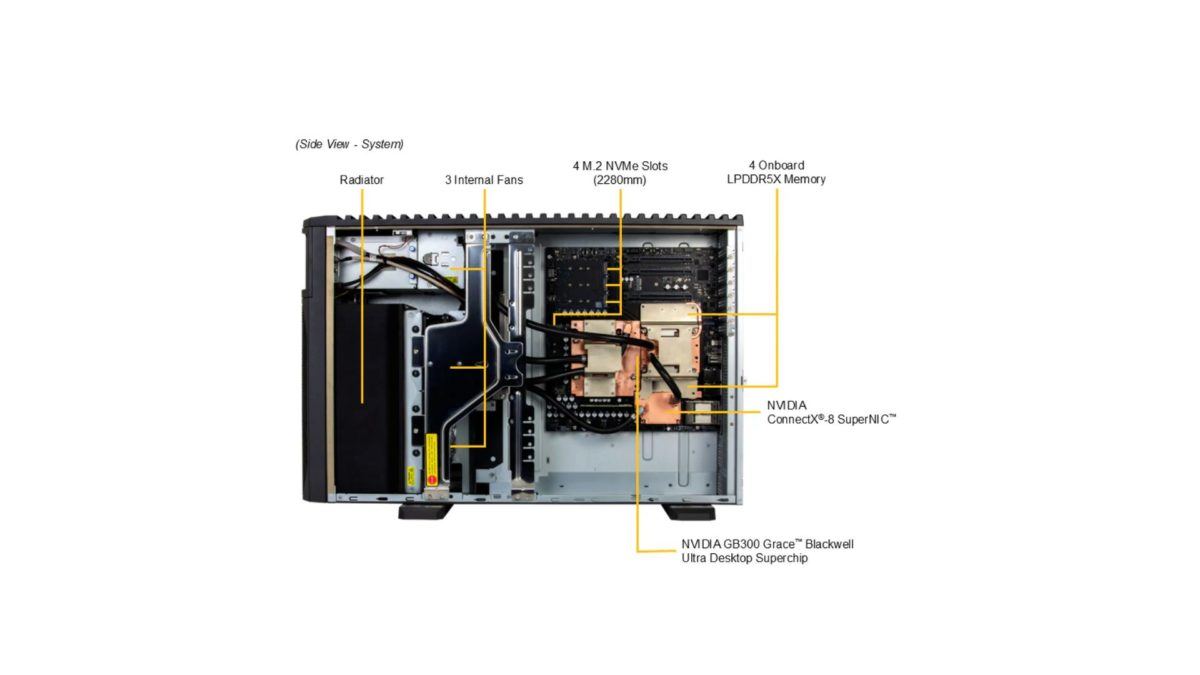
Supermicro’s ARS-511GD-NB-LCC Super AI Station puts the same B300 silicon you’d run at rack scale into a single node you can install yourself.
Announced at NVIDIA GTC 2026, it pairs the NVIDIA GB300 Grace Blackwell Ultra Desktop Superchip’s 72-core Grace CPU and B300 GPU over NVLink-C2C in a tower or 5U chassis, with 252GB HBM3e alongside 496GB LPDDR5X for 748GB of coherent memory and up to 20 PFLOPS of AI performance. Networking comes from a ConnectX-8 SuperNIC with two 400GbE QSFP ports, so it drops into the same fabric you’d use for a production node rather than sitting behind a workstation NIC.
At a mere 21.8cm tall and 45.5cm wide, it sits on a desk rather than demanding a data hall booking.
Why it works so well for research, inference, and model training
Look at where Blackwell Ultra is going at scale, and the case for a desk-sized version follows on its own.
Barcelona Supercomputing Center is upgrading MareNostrum 5 into a EuroHPC AI factory built on GB300 NVL72 systems, targeting around 20 exaflops of AI training performance. It’s one of 35 NVIDIA AI supercomputers now in development across 23 European countries, covering climate science, healthcare, clean energy and quantum computing for around three million researchers. This is the generation that scientific computing will be running on for the next several years.
Very little of that work starts at rack scale. It starts with a team testing an approach on whatever hardware they can get time on, and every step between that machine and the target architecture is somewhere results stop translating.
A research team fine-tuning against its own dataset gets a 748GB coherent pool across CPU and GPU, so a model that would have needed sharding across several GPUs simply fits in one address space.
An inference or data science team validating a production configuration gets real Blackwell Ultra throughput and memory-pressure figures, measured rather than extrapolated from Hopper or a single PCIe card.
For teams earlier in AI development, the Grace-Blackwell generation underneath the desk unit is the generation underneath the eventual cluster, running the same CUDA-X stack and the same NVLink-C2C memory model. Kernel behaviour, fine-tuning runs and pipeline development carry across. If you started on DGX Spark, this is the step up that keeps the same idea intact putting real silicon on your desk.
Be clear about what doesn’t carry across. The desk unit runs a single GPU, so multi-GPU parallelism strategy and interconnect behaviour still get validated on the cluster itself. What you gain is everything upstream of that, done on hardware of the right generation, before the rack arrives.
That’s worth working out early. For some workload profiles a desk unit is the right way to de-risk a cluster build, and for others the profile points straight at sizing NVL72 and skipping the intermediate step.
