Understanding NVIDIA’s 4-Way NVLink Bridgeboard
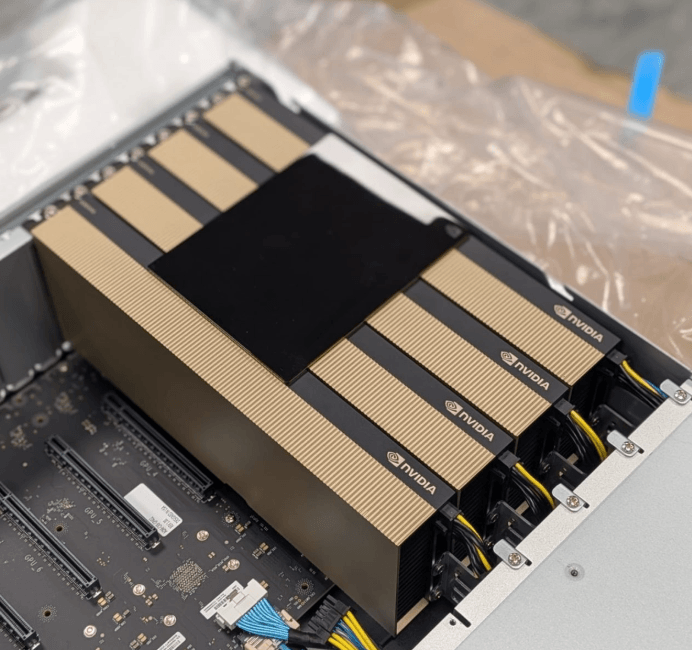
We recently had an NVIDIA H200 NVL platform in the lab, complete with the new four-way NVLink bridgeboard, as part of a customer deployment. As with every new platform we bring in, we spent time validating the hardware, testing different deployment scenarios and making sure everything behaved as expected before it reached the customer environment.
One component generated almost as much discussion as the GPUs themselves: the four-way NVLink bridgeboard.
At first glance, it doesn’t look particularly remarkable. It sits across the top of four PCIe GPUs, physically linking them together. But that simple piece of hardware is solving one of the biggest challenges in modern AI infrastructure: how do you make four GPUs behave less like four separate processors and more like a single compute resource?
The answer says a great deal about how AI infrastructure is evolving. As GPUs have become faster and AI models have grown larger, the challenge is no longer just the performance of an individual GPU. Increasingly, it’s how efficiently multiple GPUs can communicate and work together on the same workload.
Why GPUs need to communicate
Training large language models, running HPC simulations or fine-tuning foundation models rarely happens on a single GPU. Most of these workloads need multiple GPUs working together, constantly exchanging data as they process different parts of the same job.
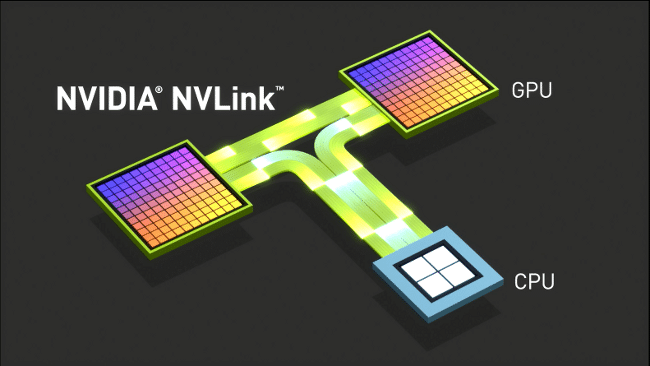
Without a dedicated interconnect, that communication happens through the PCIe bus and CPU. Every time one GPU needs information held by another, the data has to follow a much longer path through the system. As GPU performance continues to increase, that communication overhead becomes a larger proportion of the overall workload.
The challenge isn’t that PCIe is slow. It’s that modern AI workloads are increasingly communication-heavy, and the more frequently GPUs need to exchange data, the more valuable a direct connection becomes.
What NVLink changes
This is exactly why NVIDIA developed NVLink. Rather than treating each GPU as an independent device, NVLink creates a dedicated, high-bandwidth path between them. Data moves directly from GPU memory to GPU memory without continually involving the CPU, reducing latency and allowing GPUs to work together far more efficiently.
The four-way bridgeboard introduced with H200 NVL extends that concept further.
Previous H100 NVL systems supported two-way NVLink, allowing pairs of GPUs to communicate directly. H200 NVL expands this into a four-way NVLink domain, connecting four GPUs together with up to 1.8TB/s of aggregate GPU-to-GPU bandwidth and a combined 564GB pool of HBM3e memory.
Compared with the previous generation, the change is significant.
| Feature | H100 NVL | H200 NVL |
| NVLink topology | 2-way | 4-way |
| GPU-to-GPU bandwidth | 600GB/s | 1.8TB/s |
| Combined HBM memory | 188GB | 564GB |
Why it matters in practice
As AI models continue to grow, memory capacity is becoming just as important as raw compute performance. Larger models require larger memory pools, and splitting those models across disconnected GPUs introduces additional complexity and communication overhead.
By allowing four GPUs to operate within the same NVLink domain, H200 NVL provides a much larger shared memory space than previous PCIe platforms. Bigger models can remain together for longer, data moves more efficiently between GPUs, and less time is spent waiting for information to arrive.
That makes the platform well suited to workloads such as large language model training and inference, retrieval-augmented generation (RAG), scientific simulation, digital twins and other HPC applications where GPUs are continually exchanging data.
The bridgeboard isn’t making each GPU faster. It’s making four GPUs work together more effectively.
NVLink is only part of the picture
It’s equally important to understand where NVLink stops.
The bridgeboard only connects GPUs inside a single server. As soon as a workload extends beyond that node, communication moves onto the network.
This is where technologies such as NVIDIA Spectrum-X, RoCE, GPUDirect and NCCL become part of the architecture. NVLink provides efficient communication within the server, while the network is responsible for moving data efficiently between servers in the wider cluster.
The two technologies solve different problems, but together they create the communication fabric that modern AI infrastructure depends on.
Looking beyond the bridgeboard
As models continue to increase in size, moving data efficiently between GPUs is becoming just as important as adding more compute. Technologies such as NVLink are increasingly about enabling systems to behave as a single, coherent platform rather than simply connecting more hardware together.
If you’re evaluating H200 NVL or trying to understand whether your workloads would benefit from NVLink, we’re always happy to talk through the architecture and help determine where it makes sense within your wider infrastructure.
