What is Immersion Cooling for the Data Centre?
How Data Centre Immersion Cooling Works, Why it’s Necessary, and Who’s Using It
Scott Constable, Alliances Director at Vespertec
Ever since our ancestors crawled their way out of the ocean, humanity has made its home on dry land. However, data centres — the height of our modern technological abilities — seem to be evolving in the other direction. Top-end hardware like the University of Waterloo’s Nibi supercomputer packs more than 700 nodes and 140,000 CPU cores into a single system, drawing massive amounts of power and reaching scorching heat temperatures. This has created pressure for a new type of thermal management in the data centre: immersion cooling. i
Immersion cooling is one of the most efficient forms of cooling for data centre hardware. In this article, we’ll show you how it works, why it’s so important, and which organisations are already paving the way with immersion cooling.
Table of contents
- What is Immersion Cooling for Data Centres?
- When Was Immersion Cooling Invented?
- How Does Immersion Cooling Work in a Data Centre?
- Why Is Immersion Cooling Important Now?
- Who is Using Immersion Cooling Today?
- How to Get Started with Immersion Cooling
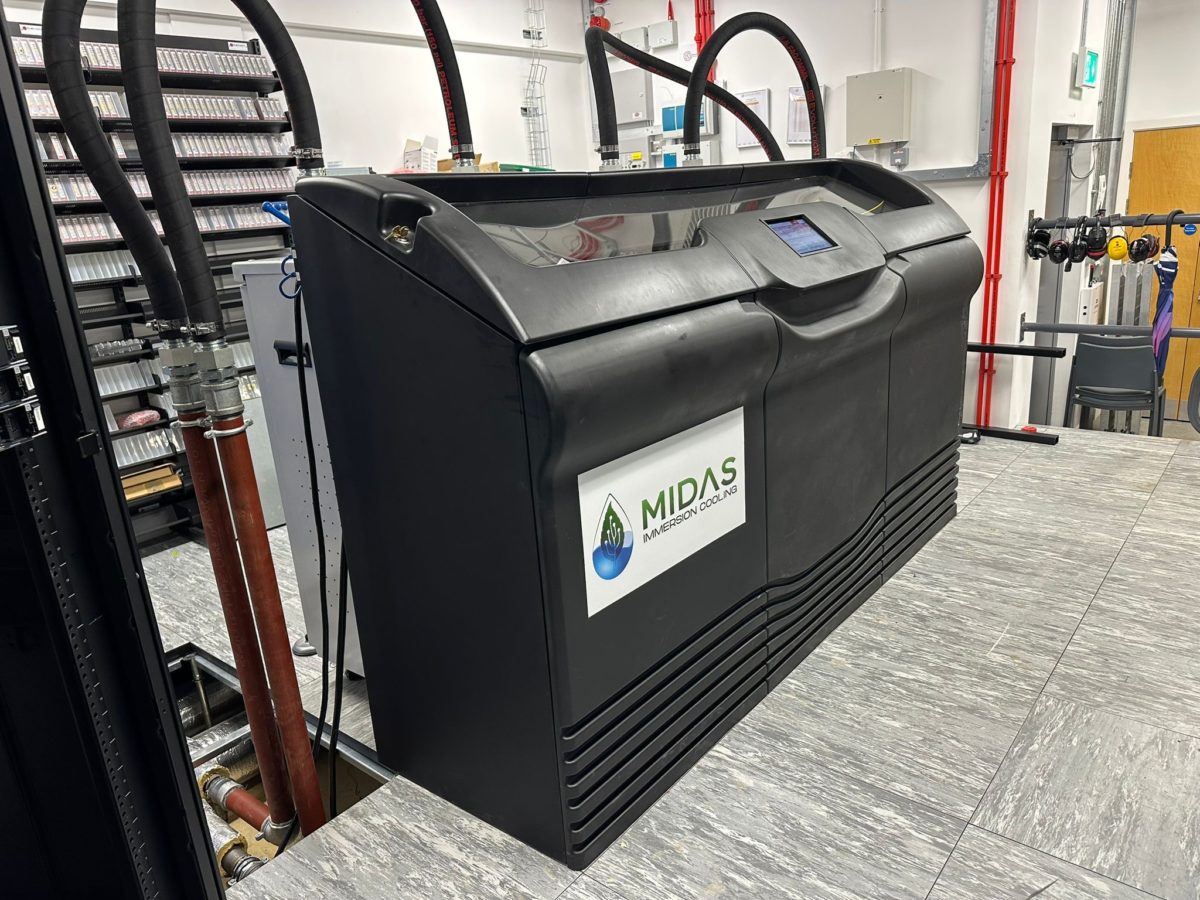
Figure 1: A 50U Midas XCI Immersion Cooling Tank Installed in Durham University’s DiRAC High Performance Computing Facility.
What is Immersion Cooling for the Data Centre?
Most data centre equipment today is cooled using either fans (air cooling) or water (liquid cooling). There are two main types of liquid cooling: Direct Liquid Cooling (DLC) or Direct-to-Chip cooling (D2C), both of which, notably, do not involve water directly touching the hardware.
The third type is immersion cooling, where servers are immersed directly into tanks of non-conducting, dielectric fluid that cool them down without causing an electrical short.
We’ve seen immersion rise to prominence in recent years largely driven by the rise in power density and energy prices, creating the need for a more power-, cost-, and space-efficient method for data centres.
When Was Immersion Cooling Invented?
Technically, immersion cooling has been around since 1887 as part of an experiment to cool high-voltage transformers. ii In a data centre context, though, immersion began to gain recognition after it was used to help cool the new Cray-2 supercomputer in 1985. iii
We saw a lull in the use of immersion cooling during the 1990s through to the early 2010s as air-cooled systems became the default choice for data centres. Ever since the rise of Bitcoin in the mid-2010s, though, through to the AI boom of the early 2020s, immersion has experienced a real comeback to tackle the associated increase in compute density per rack.
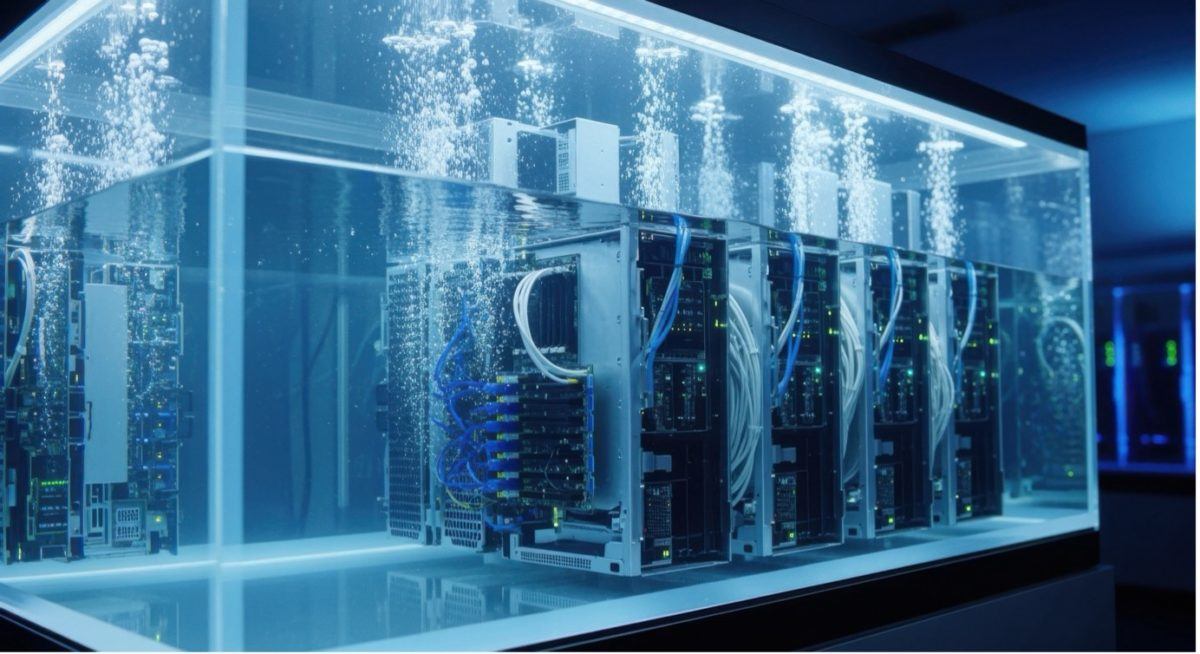
Figure 2: An AI-generated image of a transparent immersion cooling tank filled with servers.
How Does Immersion Cooling Work in the Data Centre?
Immersion cooling in the data centre works in one of two major ways: single-phase or two-phase.
Single-phase is the format you probably picture when you think about immersion cooling. It involves placing servers into a sealed metal tank of non-conductive, dielectric fluid, which can transmit heat without causing short-circuits or corrosion.
This fluid flows directly over the server components you’ve immersed and absorbs their heat, cooling the server down. Next, a pump pushes the fluid out of the tank and into a Coolant Distribution Unit (CDU). The CDU runs the warm coolant against a heat exchanger (a series of thin metal plates with cooler liquid running on the other side), and, finally, the now-cooled liquid is circulated back into the tank to begin the process again.
Two-phase immersion cooling looks slightly more dramatic than single-phase — though it’s equally safe. You use a sealed tank and a special type of dielectric fluid that has a very low boiling point (around 50–60°C). That means that, when the servers are powered on, the liquid begins to boil, pulling heat away from the servers very quickly. Eventually, the fluid turns into vapor and hits a cold condenser coil at the top of the tank, which turns it back into droplets that fall back into the fluid.
When comparing the two, you should consider the specific needs of your data centre. Single-phase cooling is simple and lower maintenance, whereas two-phase has a very high cooling capacity and can handle higher heat loads. iv
If you’d like to understand more about how to make immersion cooling work in your data centre, get in touch to set up a chat.
Why Is Immersion Cooling Important Now?
Simply put, servers have always got very hot. But in the last few years, we’ve seen a steep climb in the average data centre power consumption per rack. The Uptime Institute’s 2025 report calls out a “greater adoption of racks in the 10kW to 30kW range,” and we’re already seeing top-of-the-range racks like the NVIDIA GB200 NVL72 topping out at 140kW per rack. v
In fact, some hyperscalers are already making plans for far higher densities. At the 2025 OCP EMEA Summit, Google laid out its roadmap to support racks beyond 500kW and, ultimately, up to 1MW per rack, alongside a shift to +/-400 VDC power delivery and large-scale liquid cooling. vi
To manage that heat load, designers and original equipment manufacturers (OEMs) like NVIDIA and Supermicro, respectively, are already using DLC and D2C technology. vii For example, racks like the GB200 NVL72 already come with liquid cooling as a standard requirement. viii
Air cooling might not be relegated to the past just yet, because most data centres will contain a mixture of older and newer systems, but it’s certainly becoming a smaller part of the equation.
Thinking a step beyond that, though, forward-thinking infrastructure leads are already launching immersion cooling pilots and programmes to future-proof their projects and give them space and budget for future expansion. This is particularly important for organisations who need to prove measurable progress towards ESG metrics, like researchers and university departments.
Lenovo collaborates with NVIDIA on the design of liquid-cooled AI server systems. Speaking about DLC, Lenovo’s Jim Roche told us:
“Even today, about 20% of components on the market can only be liquid cooled. There’s no air-cooled option at all… Looking ahead, I’d expect liquid cooling to be required for a lot of technologies by the late 2020s – maybe around 2028 or 2029. Whether we as manufacturers can keep hiding that requirement from customers is another story.”
Figure 3: The interior of a typical air/liquid-cooled data centre.
Who is Using Immersion Cooling Today?
Microsoft was the first cloud provider to run two-phase immersion cooling in a production environment, according to its blog on the subject in 2021. ix Meanwhile, Australian tech firm Down Under Geosolutions (DUG) has run a 5-petaflop supercomputer named ‘Bruce’ with immersion cooling in its Perth data centre. x
What’s more, the Texas Advanced Computing Center (TACC) uses immersion cooling for its Lonestar6 supercomputer. According to a TACC announcement, approximately 70% of the system is housed in GRC immersion tanks to manage high power density. xi
But immersion cooling isn’t just for supercomputers and hyperscalers. In 2025, we worked with Durham University to install 6 AMD- and Intel-powered servers into a 50U tank from Midas Immersion Cooling, marking the next phase of Durham University’s Immersion Cooling and Heat Storage (ICHS) Living Lab, which is investigating the best way to improve Power Utilisation Efficiency (PUE) in a data centre environment. xii
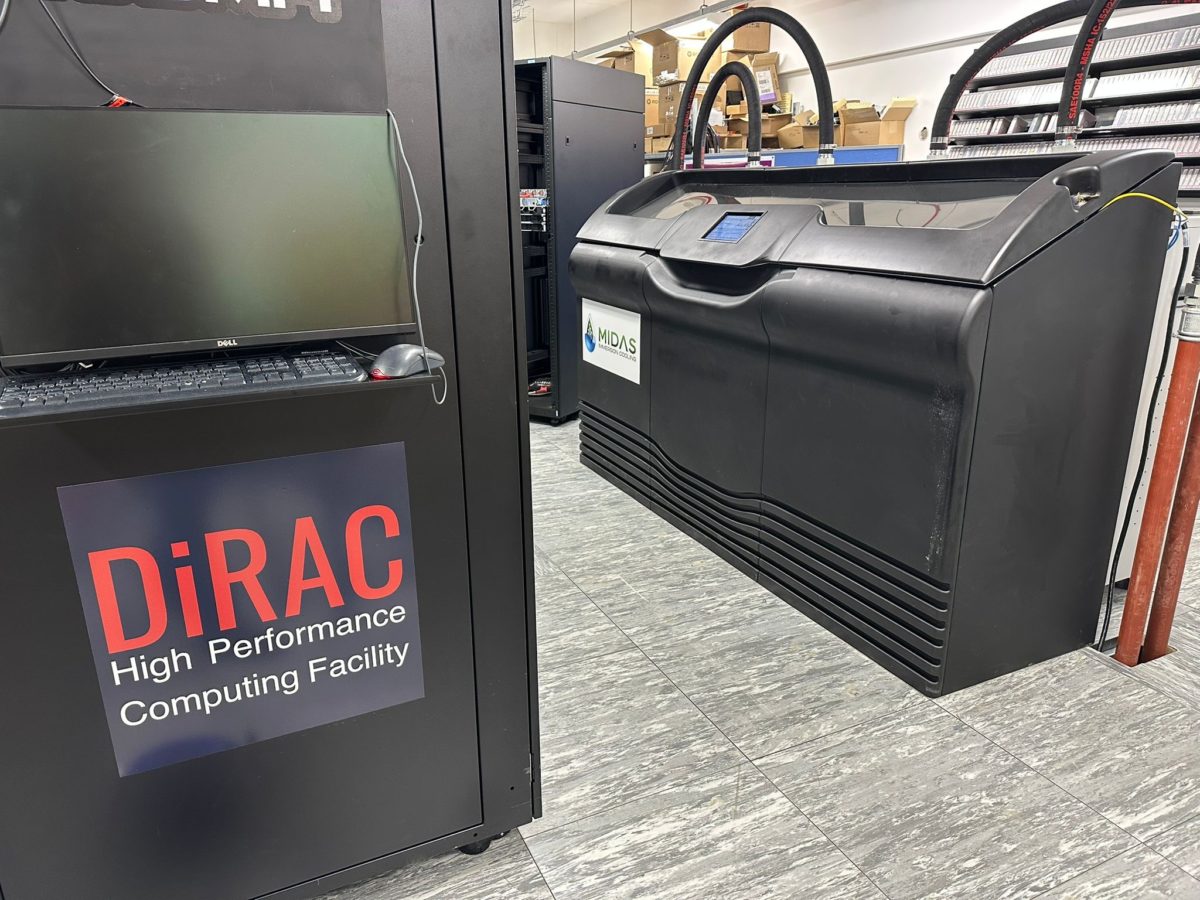
Figure 4: The 50U Midas XCI Immersion Cooling Tank Installed in Durham’s DiRAC High Performance Computing Facility.
Read our blog for a full breakdown of how Durham University scoped out its immersion cooling trial, as well as what went into the successful deployment.
How to Get Started with Immersion Cooling
If immersion is on your radar, start by looking at your projected kW per rack, whether your facility has or needs a chilled water loop, and how much headroom you’ll need over the next five years. In my most recent piece, I’ve broken down how to evaluate those factors properly and design a realistic immersion proof-of-concept.
If you’d like to have a conversation about whether immersion cooling is right for you, just fill out our contact form, send me an email at scott.constable@vespertec.com, or give us a ring at +44 161 947 4321.
References and Further Reading
i) Meet Nibi: Waterloo’s supercomputer empowering researchers in science, medicine and technology | Waterloo News | University of Waterloo
ii) Transformer’s History and its Insulating Oil, Proceedings of the 5th National Conference; INDIACom-2011
iii) Smaller and Faster: The Cray-2 and 3 – CHM Revolution
iv) Comparative Analysis: Single-Phase vs. Two-Phase Immersion Cooling – MIDAS Immersion Cooling System
v) Uptime Institute Global Data Center Survey Results 2025 – Uptime Institute
vi) Enabling 1 MW IT racks and liquid cooling at OCP EMEA Summit | Google Cloud Blog
vii) Liquid Cooling for Supermicro Servers; NVIDIA Blackwell Platform Boosts Water Efficiency by Over 300x | NVIDIA Blog
viii) GB200 NVL72 | NVIDIA
ix) To cool datacenter servers, Microsoft turns to boiling liquid
x) UWA Science faculty meets Bruce. | DUG Technology
xi) 10 Things to Know about New TACC Resources for Texas Researchers
xii) Midas Immersion Cooling: Redefining Efficiency
